"Deux blanchisseuses portant du linge" by Edgar Degas (1834-1917). Almost blind for his last twenty years, Degas worked mostly in pastel with increasingly broad, free handling. He loved to paint simple people's lives insisting on the dureness of their condition.
Five of Degas's pictures of laundresses including this one were shown at the Second Impressionist Exhibition in 1876.
In his novel the Dram Shop, French writer Emile Zola described laundresses at work, detailing the physically demanding labor involved in the act of pressing the iron. Similarly Degas emphasized the effort involved in carrying a heavy load of linen by showing the limping of the two women.
In addition to his artistic endeavors, Degas amassed a vast collection of art and considered to establish his own private museum. The museum was never realized and Degas passed away in 1917. The next year a big Degas sale was auctioned off by Christie's in London and this picture fetched 2300 Guineas (1 Gn=1 Pound and 1 Shilling).
 Nicolaes van Verendael (1640-1691) was a Flemish painter of vases with flowers. He became a member of Saint-Luc d'Anvers' craft in 1657. He didn't paint lots of pictures and lived modestly.This picture was sold in 1965 for $ 41,160.
 Painted by Alfred Sisley (1839-1899) born in Paris from English parents. Sisley was an Impressionist but was overshadowed by Monet and Renoir. After he went to London in 1871 with Claude Monet, he was influenced by Turner and even Constable.
Among Sisley's best known works are Street in Moret-sur-Loing and Sand Heaps, both owned by the Art Institute of Chicago and the Bridge at Moret-sur-Loing shown at the Musée d'Orsay in Paris.
Compared with that of his colleagues, Sisley's development was neither complex nor dramatic ; the personality his work exudes is reticent and sober, marked by some typically English severity that his French colleagues did not share. This picture fetched however $ 99,960 at a sale in 1963.
 Thomas Gainsborough (1727-1788) was an English landscape and portrait painter, one of the great English masters. He was born in Sudbury, Suffolk in the family of a clothier. At the age of 13 he was sent to London to study art. He spent several years working in the studios of different artists, one of whom was Hubert Gravelot, a draughtsman and engraver, another one was a scene-painter and illustrator Francis Hayman. In 1760 Gainsborough decided to move to Bath, where it was possible for him to have portraits commissioned by the much wealthier and nobler persons. Gainsborough became well-known there and since then always had a lot of sitters including the future George IV. In 1774 he moved to London. He was an established master by then and painted a lot of noblemen and women.He then met James Christie Sr. who established his own auction house in 1776 and made this portrait of him
(
Oil on canvas 49 5/8 x 40 1/8 in.)
. In the 1920s the picture was still in the property of the Christie family : James Archibald Christie, great-great grandson of James Christie decided to sell it in 1927. The art dealer Agnew bought it for 7,200 Guineas. During the 30s, the Art Market was depressed and Agnew could resell the picture only in 1938 to Mr Paul Getty who snapped the lot for £ 5,419 or $ 26,500 which represented at constant prices a loss of some £ 150,000. Today the picture is still the property of the Getty Center in Los Angeles.
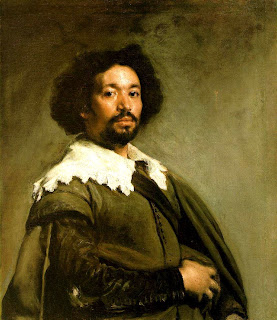 This picture, an oil on canvas (37x27.5 ins.), was painted by Diego Velazquez (1599-1660) while he was in Italy where he was unknown. He was there only because the King of Spain Philip IV wanted him to buy pictures there, and also paint the Pope. He chose as his subject his assistant and friend, Juan de Pareja, technically his slave. Velazquez sent him free later. Pareja was a Sevillian of Moorish descent of "an odd color" but on the picture he seems full of confidence and almost the equal of his master which he in some ways he was.Velazquez began to study at the age of 10 under Francisco de Herrera and left him at age 12. By the early 1620s, his position and reputation were assured in Seville. Velazquez died in August 1660 and was buried in the vault of the church of San Juan Bautista. Within eight days his wife Juana was buried beside him. Unfortunately this church was destroyed by the occupying French of Napoleon in 1811, so his place of interment has vanished.It is after this painting which was exhibited in Rome on March 19, 1650 that Velazquez did the famous portrait of Innocent X, one of Velazquez's many masterpieces, which the Metropolitan Museum of Art has been unable to secure. In 1801, this picture had been sold for 39 Guineas by Christie's auction house that was established by James Christie in 1776 in London. It was then part of the collection of Sir William Hamilton, British Minister in Naples. Hamilton had left when the French were at the gates of the city and took with him his "Portrait of Juan de Pareja".
At auction, sir William got only 39 Guineas for his beloved Velazquez. In 1811, it was acquired by the 2rd Earl of Radnor for £ 151 14s. 5d. In 1970 it was still in the property of the 8th Earl of Radnor, a non easy going character, who was persuaded to sell it. The sale of such a masterpiece was in itself a challenge. People in the art world was talking of an appraisal of about 1 million pounds. A sum never seen so far in the small world of international art. In 1970 only American museums could possibly envision such expenses and the National Gallery London wanted it desperately.
After much discussion, it was decided that the sale by auction would be the best solution. Needless to say that the sale attracted hundreds of amateurs, dealers and media people : the bidding started at 200,000 Guineas and took it up quite slowly. But step by step it passed the magical million level and the bidding became a war between art dealer Geoffrey Agnew and a young man in his early 30s whom nobody knew.
Up and up went the bid war until it passed 2 million Gns. The young man nodded gently, 2,2 million Gns. The autioneer knocked down his hammer to you.... Sir and there was a moment of panic. Who was this very young man ? Did he have the necessary funds to complete the most fabulous transaction of the Art World ? Then the young man approached the table and said he was Alec Wildenstein, son of Daniel Wildenstein, the most powerful art dealer in the world. People at Christie's sighed in relief. The Gallery Wildenstein had just bought for $ 5,5 million the famous Velazquez.
A year later, the Metropolitan Museum bought the Juan de Pareja for $ 5,6 million. Art prices have skyrocketed since the mid-1970s, and the picture could be expected to fetch easily ten times its purchase price today.