One of the most expensive pictures in the world, l'Homme à la hache (The man with an axe), was painted in 1891 as an oil on canvas in the Pacific island of Moorea (Tahiti) by Paul Gauguin (1848-1903).
Gauguin's arrival in Tahiti, after a passage of 69 days, was not especially memorable. His ship dropped anchor in the port of Papeete during the dead of night, as per normal practice, to take advantage of the high tide. Stories in the local press had anticipated Gauguin's coming, for the artist carried a commission from the French government to paint the island and its people.A young naval lieutenant named Jénot helped him get settled in town. The famous painter's presence quickly raised eyebrows--because of his longish hair, he was called taata-vahine ("man-woman"). Gauguin returned to France in August 1893, with only four francs in his pocket. He rented a room in Paris, and made use of a studio in the same building that the painter Alphonse Mucha had lent him. Gauguin convinced the dealer Paul Durand-Ruel to mount an exhibition of his new paintings. The show opened on 10 November, and consisted of 41 Tahitian paintings, plus some sculptures and three earlier Breton pictures, accounting for almost all of the work he had done in the South Seas and deemed important, including L'homme à la hache. Only eleven paintings were sold, and the show was not a financial success.
But in 2006, this picture got its revenge and reached new heights when it was sold for $ 40,33 million in New York City. This particular sale by Chrisite's set nine new auction records, including for Gustav Klimt, Egon Schiele, Ernst Ludwig Kirchner and Paul Gauguin. Klimt’s Portrait of Adele Bloch-Bauer II sold for $87,936,000 (with premium), the third highest price for a painting at auction.

 In 1994, a certain Mrs. Roscoe approached Christie's London with a small statue named the Faun, an unglazed stoneware figure supposed to have been made by Paul Gauguin (1848-1903 ) from a self-portrait (picture to the right). Mrs Roscoe had an invoice stating that the Faun was bought in 1917 from a Paris Gallery by a certain Roderick O'Conor, an artist friend of Gauguin. So she started a frenzy of speculation that "this" would be the opportunity of the century : a Faun made by Gauguin from a self-portrait posing as model. Nobody saw the irony of it or tried to think twice : there was an invoice dating back to 1917, there was the name of O'Conor, this great friend of Gauguin and there was such grace in this little faun mimicking Gauguin, it was irresistible.
So Christie's dived for it and put the Faun on auction in November 1994 : it was sold to the London dealer John Pillar for £ 20,700 ($32,500). Three years later, the statue was spooted in John Pillar's collection by the curator of the Art Institute of Chicago (whose name I won't publish by compassion for this poor man) who became keen on buying it. After some more research and horse-trading, Pillar generously consented to part with the Faun-looking-like-Gauguin for the modest sum of $ 125,000, ie a profit of $105,000 in less than three years.
Everything went well to the greatest satisfaction of every expert and museum in the world until Scotland Yard recently revealed that the Faun was a fake made by a family of forgers named Greenhalgh and living quietly in Northern England near Manchester. Mrs Roscoe was nobody else than the mother of the forger Shaun Greenhalgh. Over several decades they have forged documents, copied and sold Art works to the planet in total impunity. Dozens of complaints were however filed to Scotland Yard who never did anything about it. Why ? Shaun Greenhalgh was sentenced to four years in jail.
 Paul Gauguin (1848-1903) spent most of his time at Le Pouldu (September 1889 to November 1890) in an auberge (inn) belonging to a Mademoiselle Marie Henry, known as the Buvette de la Plage .
 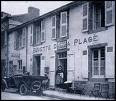 Gauguin’s social and artistic life in Le Pouldu revolved around this inn. He slept and ate there, painted, hosted his friends and artists and “fraternized with the maid” . Gauguin and his close companion, financier, and understudy Meyer de Haan had developed a regular routine that didn’t involve much more than eating, sleeping and painting.Gauguin and de Haan decided to decorate one wall of the room as a gift to Mademoiselle Henry. This idea, over the course of the year, grew to all four walls of the room as well as the ceiling, and included portraits of the main inhabitants, paintings depicting daily life at Le Pouldu, theological and mystical images, exhortations and mottos.
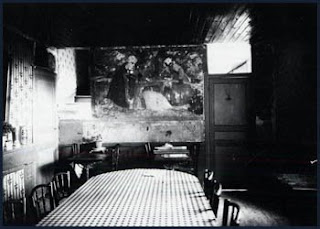 The innkeeper Marie Henry, had a daughter by de Haan, and later played a negative role in Gauguin’s life: she refused to return his works, which he had to keep in her inn for some time.These paintings were not created to please critics, not even to please potential buyers. They were created for the artists themselves to enjoy while taking their meals and entertaining each other. Those paintings are still there and can be seen on this picture to the right
 :
this room provides an intimate snapshot of the life of Gauguin that we could not necessarily learn through his letters or other paintings .
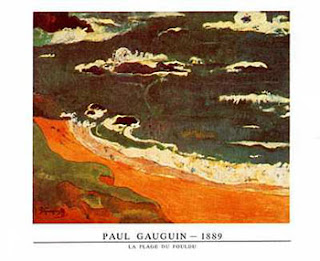
La Plage au Pouldu (Britanny, France) was part of the fabulous Henri Ford II's collection that went for sale on May 1980 ; the picture fetched $2.9 million. It has been kept by the Fords in a ....safe for many years. Gauguin would have been mad to learn about it.But he would have been madder to learn that the total of the sale reached $ 18.3 million. Henri Ford II had said that he would come to the sale but then told the auctioneers that there was a strike in Detroit and that he preferred not to be seen at the sale :"It would look very bad, he said, if I was seen to have made 10 million (the amount of the estimate) or more while I was telling the automobile constructors to get stuffed for $1.5." When the autioneers told him the sale had made 18 millions, he was nonplussed and said:"Well done, Jesus, people are crazy." People really ?
 Eugène Henri Paul Gauguin was born in Paris in June 1848, the son of Clovis Gauguin, a Republican editor, and his wife Aline Marie Chazal. In 1849, after Louis Napoléon came to power, the family emigrated to Peru. Clovis Gauguin died on the way. His widow and 2 children, Paul and his elder sister Mari, stayed in Lima with their rich relatives and did not return to France until 1855.
In 1868, Paul joined the navy, which he left after the Franco-Prussian War. Instead, he started to work as a broker’s agent in Paris. The first known drawings by Gauguin dated 1871, when he was in his late twenties. In 1874, Gauguin met Pissaro and other Impressionists. He traded at the stock exchange, which provided a comfortable income and he bought many of the Impressionists' paintings and had a handsome collection.
His début in the Salon took place in 1876. In 1883, Gauguin quit the stock exchange; financial troubles weren't long in waiting. In 1885, he left his family in Copenhagen with his parents-in-law. In 1891, he managed to organize a trip to Tahiti at the expense of the French government. In 1900, after a contract with Vollard, a Parisian dealer, his financial position improved, but his health was irreparably ruined.
In 1901 he moved from Tahiti to Atuana on the Island of Dominique in the Marquesas, where his colors grew even more abundant and lush, and where he executed such pink and mauve paintings as Horsemen on the Beach. (1902) and The Call. (1902). In 1903, Gauguin was sentences to three-months in prison and fined 1,000 francs because of problems with the church and the colonial administration. Before he could begin his sentence he died, on the 8th of May at his home in Atuana. The man was not nice but his pictures are beautifulBonjour Monsieur Gauguin is an homage and an emulation to Gustave Courbet (1819-1877) who painted a Bonjour Monsieur Courbet 
(below).
In 1969, it went in a sale in Geneva (Switzerland) for SF 1,3 million ($ 329,000). It was bought by Dr Armand Hammer, president of Occidental Petroleum, who had flown to Geneva in his private jet and landed in a snow storm, the last plane allowed to land. Later he was offered a huge profit by Onassis whose plane had been forbidden to land in Geneva. Hammer told the Greek the painting was not for sale. It is now on the walls of the Narodny Gallery in Prague (Czech Rep.).