This picture by Dutch painter Gérard David (1460-1523 ), not to be confused with French Jacques Louis David ( 1748-1825 ) was an early Netherlandish painter and manuscript illuminator known for his brilliant use of color (see picture below).
David had been completely forgotten when in the early 1860s he was rescued from oblivion by William Henry James Weale, whose researches in the archives of Bruges brought to light the main facts of the painter's life and led to the reconstruction of David's artistic personality, beginning with the recognition of David's only documented work, the Virgin Among Virgins at Rouen. Born in Oudewater, he was admitted to the painter's guild in Bruges in 1484. His works are mostly religious subjects, imbued with a gentle piety showing the influence of the earlier Netherlandish masters, such as Jan van Eyck and Hugo van der Goes. In 1494 David became Bruges' leading painter, after Memling died. In the 1970s this picture was found with a lot of bric-à-brac in the vestry of All Hallows Berkyngechurch-by-the-Tower, the oldest church in the city of London.
It had originally been given to the Rev. Clayton, vicar of All Hallows fron 1922 to 1963. When it came up for sale in 1973, it made 160,000 Gns. ($ 420,000).
Millais : The Proscribed royalist In the last half of the 19th century there were literally scores of great art ateliers and academies turning out thousands of highly trained and accomplished artists, painting in dozens of different styles and on countless different subjects. The best of the best of these were clearly amongst the greatest geniuses in western civilization. It is an incredible irony that this greatest of all periods should have become the most denigrated.
Men like William Adolphe Bouguereau, Jean-Léon Gérôme, Jules Breton, Jules Bastien-Lepage, Jean Francois Millet, Jehan Georges Vibert, Edward Burne Jones, Fredrick Lord Leighton, Edward Poynter, Sir Lawrence Alma-Tadema, John William Waterhouse, Leon L'hermitte, Sir Frank Dicksee, Sir John Everett Millais, Alexander Cabanel and Jules Lefebvre. These names, many of which may be new to you, were as well known by the cogniscenti in the 1890's as Cézanne, Picasso, Matisse, DeKooning, Jackson Pollock, and Andy Warhol are known today.
They were household names. People would line up sometimes for blocks to see exhibitions of their works. The rich, and the poor, the humble and the famous alike adored their work.
Men like Henry James, Frederic Chopin and Charles Dickens idolized these academic masters. Could such men that we all agree were beyond question great artistic geniuses themselves have had such bad taste so as to idolize art that today's ideologues would have us believe was so bad?
 Paul Gauguin (1848-1903) spent most of his time at Le Pouldu (September 1889 to November 1890) in an auberge (inn) belonging to a Mademoiselle Marie Henry, known as the Buvette de la Plage .
 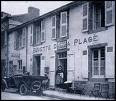 Gauguin’s social and artistic life in Le Pouldu revolved around this inn. He slept and ate there, painted, hosted his friends and artists and “fraternized with the maid” . Gauguin and his close companion, financier, and understudy Meyer de Haan had developed a regular routine that didn’t involve much more than eating, sleeping and painting.Gauguin and de Haan decided to decorate one wall of the room as a gift to Mademoiselle Henry. This idea, over the course of the year, grew to all four walls of the room as well as the ceiling, and included portraits of the main inhabitants, paintings depicting daily life at Le Pouldu, theological and mystical images, exhortations and mottos.
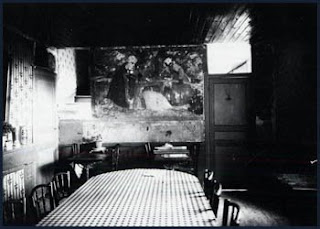 The innkeeper Marie Henry, had a daughter by de Haan, and later played a negative role in Gauguin’s life: she refused to return his works, which he had to keep in her inn for some time.These paintings were not created to please critics, not even to please potential buyers. They were created for the artists themselves to enjoy while taking their meals and entertaining each other. Those paintings are still there and can be seen on this picture to the right
 :
this room provides an intimate snapshot of the life of Gauguin that we could not necessarily learn through his letters or other paintings .
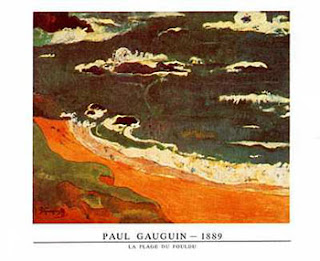
La Plage au Pouldu (Britanny, France) was part of the fabulous Henri Ford II's collection that went for sale on May 1980 ; the picture fetched $2.9 million. It has been kept by the Fords in a ....safe for many years. Gauguin would have been mad to learn about it.But he would have been madder to learn that the total of the sale reached $ 18.3 million. Henri Ford II had said that he would come to the sale but then told the auctioneers that there was a strike in Detroit and that he preferred not to be seen at the sale :"It would look very bad, he said, if I was seen to have made 10 million (the amount of the estimate) or more while I was telling the automobile constructors to get stuffed for $1.5." When the autioneers told him the sale had made 18 millions, he was nonplussed and said:"Well done, Jesus, people are crazy." People really ?
 Peter Paul Rubens was born in 1577 in Westphalia to Jan Rubens and Maria Pypelincks. His father, a Calvinist, and mother had fled Antwerp for Cologne in 1568, after increased religious turmoil and persecution of Protestants during the rule of the Spaniard, the Duke of Alba.
Rubens was the most renowned northern European artist of his day, and is now widely recognized as one of the foremost painters in Western art history.The Massacre of the Innocents refers to the Bible (Matthew 2:16) that describes a massacre of babies on order of King Herod after hearing of the birth of a new king, Jesus, in his realm. This incident, known as the massacre (or slaughter) of the innocents, exemplifying the horror of harming children with the power of the state, has inspired artists over many centuries :
Giotto, Duccio, Fra Angelico, Bruegel, Tintoretto, Lebrun, Poussin, Doré...In 2002, this picture (142 x 182 cm) painted in 1611-12 was sold by Sotheby's London for £ 49.5 million (then equal to some $ 86 million). The buyer was later revealed to be the Canadian press baron Kenneth Thomson, 2nd Baron Thomson of Fleet. The price was then the most expensive Old Master painting ever sold at auction. It is now on loan at the National Gallery London.
Towards the end of his life, between 1636 and 1638, Rubens painted a second version of the Massacre of the Innocents. This version was acquired by the Alte Pinakothek in Munich in the XVIIIth century and it continues to hang there today. He died from gout on May 30, 1640. He was interred in Saint Jacob's church, Antwerp. The artist had eight children.
 Andrea Mantegna (1431-1506), together with his brother-in-law Giovanni Bellini, was largely responsible for spreading the ideas of the Early Renaissance in northern Italy. In 1460, Mantegna became court painter to the Gonzaga family in Mantua. After that he only left Mantua for occasional trips to Tuscany and Rome. In about 1490, Mantegna began to produce engravings of great artistic and technical perfection, which contributed greatly to the dissemination of the Early Renaissance innovations north of the Alps. Andrea Mantegna's composition of figures and objects compressed within a shallow space was based on his study of ancient Roman reliefs. He used a neutral background and sharply defined details to focus the viewer's attention on the kings' adoration of Christ. Mantegna died in Mantua, on September 13, 1506. In 1516 a handsome monument was set up to him by his sons in the church of Sant'Andrea, where he had painted the altar-piece of the mortuary chapel. The dome is decorated by Correggio.In 1985, the Adoration -painted between 1495 and 1505- part of the collection of the Marquess of Northampton was one of the last paintings by Mantegna in private hands. It is rather small (21.5 x 27.5 ins) and was painted in tempera and oil linen laid down on a canvas. It was bought for $10.4 million by the P.Getty Museum of Malibu, Calif.
 This picture by Dutch painter Gérard David (1460-1523 ), not to be confused with French Jacques Louis David ( 1748-1825 ) was an early Netherlandish painter and manuscript illuminator known for his brilliant use of color (see picture below).