Showing posts with label Koons. Show all posts

Monday, December 29, 2008

AND THE 2008 WINNERS ARE..... BACON, MONET, MUNCH, KOONS AND GUSTON

In the midst of a market that remained on a crazy price trend for a long time before to cool off towards the end of the year, five paintings fetched very high prices in 2008. Good thing for the houses that auctioned them off, four of them were overvalued while only one was on the money.

The absolute winner is Francis Bacon's Triptych executed in 1976 that was acquired in May by Russian trophy-hunter Roman Abramovich for upward of $ 86,2 million, making it the fourth most expensive painting to sell at auction, behind two Picassos and a Gustav Klimt. Abramovich, 42, qualified for the Sunday Times Rich List 2008, with an estimated fortune of £11.7 billion ($16 billion)(1).

Forbes magazine ranked him as the fifteenth richest person in the world. He was considered to be the second richest person currently living within the
United Kingdom in 2008. In my opinion, this price was grossly overvalued but if the auctioneers can find a foolish Russian nouveau-riche to increase their bottom-line, I do not see any reason to spoil their joy. This picture will never sell again at this price.

The second overvalued winner of the year is Claude Monet's rather gloomy
Le bassin aux Nymphéas executed in 1919 that fetched the price of $ 40.9 million in June. This oil on canvas measuring 39 1/2 by 79 1/8 inches was acquired by London based art advisor Tania Buckrell Pos of Arts & Management International who beat telephone competition for the dark abstraction, and the final sale price shattered the artist’s record. This painting had been owned by the the California industrialist philanthropist Norton Simon who in other times terrorized the people of Christie's.

The third winner of 2008 is Edward Munch's beautiful and awe inspiring Vampire Love & Pain executed in 1894 depicting a woman with long, flaming red tresses biting the neck of a submissive male. The picture made a record price of $38,162,500 in November in a market that had become definitely depressive. The wealth of oil-rich Norway has flung Munch’s star higher in the past few seasons, though this contest, with at least four suitors chasing the prize, eclipsed the previous mark of $30,841,00, set by "Girls on a Bridge" (1902) at Sotheby’s New York in May.

Edvard Munch ( 1863 – 1944) was a Norwegian Symbolist painter, print maker, and an important forerunner of expressionistic art. A macabre quality pervaded his early work. Munch came to Paris in 1889 and based his expressive style on Toulouse-Lautrec, Van Gogh and Gauguin.

The fourth winner of 2008 is the inevitable Englishman Jeff Koons whose Balloon Flower (Magenta) (1995–2000) - a nine-ton, high-chromium stainless steel monument from 1995/2000- that fetched the inflated and overvalued sum of £12,921,250 ($18 million)(1) in June and filled the pocket of the Dallas-based collector Howard Rachofsky.

Jeff Koons was born in York (Pennsylvania in 1955) and studied at the Art Institute of Chicago and the Maryland Institute of College Art. Koons has long been known as a good self-promoter who relies on shiny, kitschy images to gain public attention.

The chateau de Versailles (France) near Paris recently held a Koons exhibit that costed 1.9 million Euros, 800,000 of which went solely to the Split Rocker which is in the gardens and is a reference to Le Nôtre.

Last winner of the year, the nice Beggar’s Joys (1954–55) by Canadian-born Philip Guston (1913-1980) who was a notable painter and printmaker in the New York School, which included many of the Abstract Expressionists, such as Jackson Pollock and Willem De Kooning. This picture fetched only $10,162,500 versus an estimate of $14–18 million.

It is probable that Sotheby's overlooked the fact that Guston is unknown in Europe, at least in comparison to the pantheon of ex-colleagues such as de Kooning, Pollock, and Rothko. The work set a record for the under-appreciated American artist nevertheless.

In my opinion, this picture altough extremely nice and attractive was also grossly overvalued but it seems that Guston is a rising star as -in May 2005- his very similar "The Street" from 1956 made $7,296,000.

The work sold in the salesroom to San Francisco art adviser Mary Zlot, who is known to counsel Bay Area billionaires Charles Schwab and George Roberts.

(1) At 29th of December 2008 rate of exchange

Monday, December 22, 2008

IS CONTEMPORARY ART PORNOGRAPHIC ?

No, contemporary art is not pornographic per se, it is only very willingly and complacently provocative in a manner than even the Cubists and the Surrealists were not.

And any artist or art amateur knows that the best way to be provocative and to draw attention -especially if you are talented, innovative and original- is to make your works border on pornography. He who can the most can the least. And if pornography is the picture which is being 'too close' whilst erotica is the picture which is 'leaving room for the imagination', then Jeff Koons' painting on the right is pornographic.

The "Red Butt" of the series Made in Heaven by Jeff Koons shows him in close action with his then wife Anna Ilona Staller also known as La Cicciolina. (the most intimate details were censored by me). Hungarian-born Italian porn-star, Staller married Koons in 1991 and left him two years later. A son was born of their short union in 1992 and in 2008 Staller filed suit against Koons for failing to pay child support. When you think that he is one of the richest painters in the world, it leaves you thinking....

Anyway, this artistico-pornographic picture - that will probably never hang in a museum -and was certainly not shown at any Koons retrospective- is a 90x60 in. silkscreen made in 1991 and is # one of an edition of one plus one artist's proof which no longer exists. In 2003, Christie's sold one of them for $369,000 after a bidding war involving 9 bidders. In May 2005, the same auction house sold it again for $520,000 . I do not know if Contemporary art is pornographic but I am sure it can be and that it sells very well.

Of course like some critic you can always justify pornography in the Art by writing something like : "Instead of a porno show, the effect is like that of Japanese erotic prints, where the degree of stylization is so exaggerated that the sexual acrobatics as such are quickly submerged in an all-engulfing artifice." (Robert Rosenblum in The Jeff Koons Handbook, Rizzoli, London, 1992, p.25). But you will fool nobody for yourself, not even the fools who bought it for what it is : a pornographic picture made by a very talented artist.


Thursday, December 4, 2008

WHO ARE THE MOST EXPENSIVE AMERICAN PAINTERS ?

The 10 most expensive American painters are Rothko, Warhol, Bellows, De Kooning, Hopper, Koons, Smith, Sargent, Feininger and Peale.

Mark Rothko, born Marcus Rothkowitz (1903–1970), was a Latvian-born American painter and printmaker who is classified as an abstract expressionist, although he rejected not only the label but even being called an abstract painter.

He emigrated with his mother and sister in the USA in 1913 and went to the New School of Design in 1923 , where one of his instructors was the artist Arshile Gorky.

Rothko suffered from an aneurysm in 1968 and committed suicide in 1970. He was entered in Sharon Gardens in Kensico Cemetery in Valhalla, N.Y. The most expensive of his work was sold for $ 72,8 million in May 2007 and was a picture titled White Center.

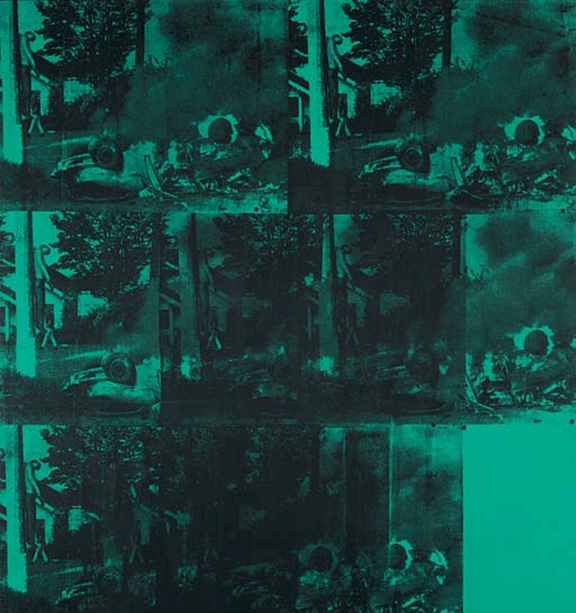
Second is the inimitable Pittsburgh-born Andy Warhol whose
Green Car Crash sold in 2007 for $ 71,7 million. Andrew Warhola (August 6, 1928 – February 22, 1987) was an American artist and a figure in the movement known as pop art. After a successful career as a commercial illustrator, Warhol became famous worldwide for his work as a painter, avant-garde filmmaker, record producer, author, and public figure.

On June 3, 1968, crazy feminist anti-male Valerie Solanas shot Warhol and art critic Mario Amaya at Warhol's studio. Warhol died in New York City at 6:32 a.m. on February 22, 1987. According to news reports, he had been making good recovery from a routine gallbladder surgery at New York Hospital before dying in his sleep from a sudden post-operative cardiac arrhythmia. Prior to his diagnosis and operation, Warhol delayed having his recurring gallbladder problems checked, as he was afraid to enter hospitals and see doctors. The wounds of the 1968 shot left serious complications that certainly led to his sudden death.

The third of the most expensive Americans is George W.Bellows
(1882-1925), a painter, known for his bold depictions of urban life in New York City. At a young age he was to become "the most acclaimed artist of his generation". Bellows was born in Columbus, Ohio.

Bellows was soon a student of Robert Henri at the
New York School of Art, and became associated with Henri's "The Eight" and the Ashcan School, a group of artists who advocated painting contemporary American society in all its forms. By 1906, Bellows was renting his own studio. He died on January 8, 1925 in New York City, of peritonitis, after failing to tend to a ruptured appendix.

His mots expensive work was sold in 2007 for $ 27.7 million and is titled
Men of the Docks , painted in 1912, a monumental masterwork by the undisputed leader of the Ashcan School.

Fourth is the famous Dutch-American Willem de Kooning ( 1904 – 1997) an abstract expressionist painter, born in Rotterdam (The Netherlands). His early artistic training included eight years at the Rotterdam Academy of Fine Arts and Techniques. In the 1920s he worked as an assistant to the art director of a Rotterdam department store. In 1926, De Kooning entered the United States as a stowaway on a British freighter and in 1927 he settled in Manhattan. In October 1935, De Kooning began to work on the WPA (Works Progress Administration) Federal Art Project, and he won the Logan Medal of the arts.

Developing a bold style of gestural paintings, he produced figure paintings and abstract, urban landscapes throughout the 1950s. In the following decade, pastoral themes replaced the urban violence of his earlier expressionist work. In 1963, de Kooning moved from a Manhattan loft to his newly built studio in the East Hampton community of the Springs. The North Atlantic light and flat beaches of Long Island inspired the luminous paintings of de Kooning's later career.

He made many canvasses about women, all distorted and rather monstruously looking. For that reason, he has sometimes been accused of being a woman-hater. In the 80s, Willem de Kooning was diagnosed with, in all probability, Alzheimer's disease. After his wife, Elaine, died on February 1, 1989, his daughter, Lisa, and his lawyer, John Eastman were granted guardianship over a De Kooning, alcoholic and sick. His most expensive work Untitled XXY sold in 2006 for $ 27.1 million.

Fifth place is Edward Hopper (1882 – 1967), a prominent realist painter and printmaker. While most popularly known for his oil paintings, he was equally proficient as a watercolorist and printmaker in etching. Hopper was born in upper Nyack, New York, a yacht-building center north of New York City, the only son of comfortably well-off middle class family.

His parents were of Dutch ancestry. Hopper began his art studies with a correspondence school in 1899. Soon, however, he transferred to the far more prestigious New York Institute of Art and Design. There he studied for six years, with teachers including
William Merritt Chase who instructed him in oil painting. In 1913, at the famous Armory Show, Hopper sold his first painting, Sailing (1911), which he painted over an earlier self-portrait. Hopper was thirty-one. At forty-one, Hopper finally received the recognition he had sought, but he continued to harbor bitter feelings about his career, later turning down appearances and awards.

His financial stability now secured, Hopper would live a simple, stable life and continue creating art in his distinctive style for four more decades. He died in 1967, in his studio near Washington Square, in New York City. His wife, who died 10 months later, bequeathed their joint collection of over 3,000 works to the Whitney Museum of American Art. His Hotel Window painting -an oil on canvas made in 1955- fetched $26.8 million in November 2006 at Sotheby's. It has been estimated at 10-15 million.

The following most expensive American painter is the provocative and publicity-hungry Jeff Koons, born in York, Pennsylvania in 1955. He studied at the Maryland Institute College of Art in Baltimore and the School of the Art Institute of Chicago.

He received a BFA from the Maryland Institute College of Art in 1976. Mr. Koons lives and works in New York City and York, Pennsylvania. Koons is also known for his public sculptures, such as the monumental floral sculptures Puppy, shown at Rockefeller Center and permanently installed at the Guggenheim Bilbao, and Split-Rocker, exhibited at the Palais des Papes in Avignon, France. Most recently, in 2006, Balloon Flower (Red) was unveiled at 7 World Trade Center in New York City and he held a very controversial show in Fall 2008 at the Chateau de Versailles, near Paris.

His most expensive work Hanging Heart sculpture (above) fetched $ 25.7 million at a Sotheby's sale in New York in November 2007. The 9ft-tall sculpture was created in stainless steel and consists of a giant heart, weighing 3,500lbs (1,600kg), suspended from the ceiling by two delicate gilded strands and hovering 16 inches (40cm) from the floor. The sculpture took 10 years to complete and was bought by the NYC-based Gagosian Gallery.


Another expensive American artist is an Abstract Expressionist sculptor, named David R. Smith (1906-1965), founding member of the American Abstract Artists group in 1936 whose most expensive piece called Cubi XXVIII went for $ 23.8 million in 2005.
It became the most expensive contemporary artwork ever sold at auction.

Art dealer Larry Gagosian, bidding on behalf of billionaire Eli Broad (from Kauffman and Broad), won it at Sotheby’s for this huge sum of money. “I was prepared, frankly, to pay
more than what I bid,” Broad said after the sale. The deep-pocketed collector is funding the $60 million expansion of the Los Angeles County Museum of Art, where the Smith is now on display.

Smith came to sculpture through painting, having trained at the Art Students League from 1927 to 1932. Like many of his fellow artists, he then worked in the WPA Federal Art Project. Significant friendships—and aesthetic affinities—with John Graham, Jackson Pollock, Robert Motherwell, and many of the Abstract Expressionist painters contributed to his development.

Profoundly influenced by the welded sculptures of Julio González and of Picasso, Smith started devoting himself entirely to metal sculptures, constructing compositions from steel and "found" scrap material. In the summer of 1929, Smith, along with his then wife Dorothy Dehner, bought a house in Bolton Landing, in upstate New York and won the Logan Medal of the arts.

He began his
Cubi series of monumental, geometric steel sculptures in 1961 (although he began in earnest only in 1963). They are considered some of the most important works of 20th century American sculpture. In recognition of his influence on abstract expressionism, Smith was appointed to the National Council on the Arts by President Lyndon B. Johnson in 1965. However, at the peak of his influence and still working on Cubi, he died in a car crash near Bennington, Vermont in May 1965.

Still in the range of the 20 million dollars, we have the painter John S. Sargent,
( 1856–1925) who was the most successful portrait painter of his era. Born in Florence Italy from American parents John Singer Sargent had an attempt to study at the Academy of Florence but he failed, so he went to Paris where he began his art studies with Carolus-Duran.

The young French portrait artist, who had a meteoric rise, was noted for his bold technique and modern teaching methods, and his influence would be pivotal to Sargent during the period from 1874-1878.
In 1874, on the first attempt, Sargent passed the rigorous exam required to gain admission to the École des Beaux-Arts.

During his career, he created roughly 900 oil paintings and more than 2,000 watercolors, as well as countless sketches and charcoal drawings. His oeuvre documents worldwide travel, from Venice to the Tyrol, Corfu, the Middle East, Montana, Maine, and Florida. After leaving Carolus-Duran’s atelier, Sargent visited Spain. There he studied the paintings of Velazquez with a passion, absorbing the master’s technique, and in his travels gathered ideas for future works.

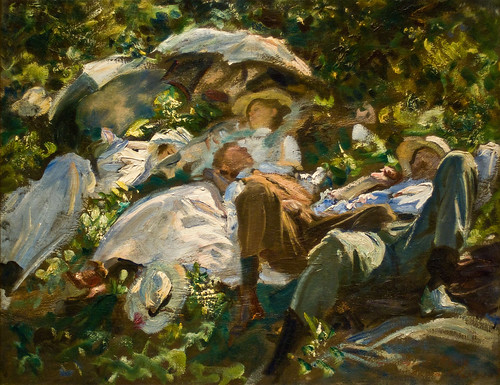
In a time when the art world focused, in turn, on Impressionism, Fauvism, and Cubism, Sargent practiced his own form of Realism, which brilliantly referenced Velázquez, Van Dyck, and Gainsborough. His seemingly effortless facility for paraphrasing the masters in a contemporary fashion led to a stream of commissioned portraits of remarkable virtuosity among them Teddy Roosevelt. In December 2004, Group with Parasols (A Siesta) (1905) sold for $US 23.5 million, nearly double the Sotheby's estimate of $12 million. The previous highest price for a Sargent painting was $US 11 million.

The ninth man on the list of the most expensive American artists is Lyonel Feininger (1871-1956) born to parents of German American descent and who grew up in New York City. Feininger only started working as an artist at the age of 36, after having worked as a commercial caricaturist for twenty years for various newspapers and magazines in both the USA and Germany; he was a member of the Berliner Sezession . He designed the cover for the Bauhaus 1919 manifesto - an expressionist woodblock 'cathedral'- and also taught at the Bauhaus for several years. In 1921, he had a joint exhibition with Paul Klee at the Weimar Museum.

With Cubist style and evocative color, he depicted modern life, especially factories, bridges, ships, harbors, and buildings. His most expensive painting The Jesuits III made in 1915 sold for
$23,2 million estimated $7 - 9 million at Sotheby's NY on May 8 th 2007.

The less expensive of the most expensive is Charles W. Peale (1741-1827), born in Chestertown, Maryland. He followed for some time the trade of a saddler in Annapolis, but, having seen a portrait while visiting Norfolk, Virginia, he determined to attempt art, and on his return he executed a likeness of himself. His success induced him to change his vocation from saddle making to portrait painting. He lived in Boston in 1768'9, where he had some instruction from John Singleton Copley, and in 1770 he went to London, England, bearing letters to Benjamin West, who received him kindly, and whose pupil he became. He returned to Annapolis in 1774, began painting portraits, and two years later established himself in Philadelphia.

He also began to take an active interest in political affairs, and was a member of the legislature in 1779. Afterward he turned his attention to natural history : he lived to assist in establishing the Pennsylvania academy of the fine arts and to contribute to seventeen of its annual exhibitions. Peale is notable rather for versatility than for real genius in any direction and his fame rests mainly on his achievements as a portrait painter, among which those of George and Martha Washington, John Hancock, Benjamin Lincoln, Baron Steuben, Count Rochambeau, Benjamin Franklin, Thomas Jefferson, John Witherspoon, and Alexander Hamilton f James Monroe, Andrew Jackson, John Quincy Adams, John C. Calhoun, and Henry Clay .

He opened in Philadelphia his own museum that housed a diverse collection of botanical, biological, and archaeological specimens. Most notably, the museum contained a large variety of birds which Peale himself acquired, and it was the first to display North American
mammoth bones and it became eventually the Peale Museum. I n January 2005, a full length portrait of "Washington at Princeton" from 1779 sold for $21.3 million - setting a record for the highest price paid for an American portrait.

The popular success of George Washington at Princeton led to orders for as many replicas as Peale could produce. In August 1779 the artist wrote: “I have on hand a number of portraits of Gen. Washington. One the ambassador had for the Court of France, another is done for the Spanish Court, one other has been sent to the island of Cuba, and sundry others, which I have on hand are for private gentlemen.” Versions vary in size and composition–-with the background and the treatment of the figure of Washington altered by Peale. Changes included replacing the soldiers and horses with a bleak winter landscape, updating the general’s insignia according to the most recently issued orders, and giving greater prominence to the colonial flag. Other full-length versions by Charles Willson Peale are found at Princeton University in New Jersey, the Metropolitan Museum of Art in New York, Colonial Williamsburg, and the Virginia Museum of Fine Arts.


Thursday, November 27, 2008

JEFF KOONS : CATERPILLAR CHAINS and CHEEKY


Jeff Koons was born in York Pennsylvania in 1955 and studied at the Art Institute of Chicago and the Maryland Institute of College Art. Koons has long been known as a good self-promoter who relies on shiny, kitschy images to gain public attention.

The chateau de Versailles (France) near Paris recently held a Koons exhibit that costed 1.9 million Euros, 800,000 of which went solely to the Split Rocker which is in the gardens and is a reference to Le Nôtre.

After less glamorous year in the 80s, today Jeff Koons' work records terrific sales. This is an interesting fact considering the world's economy is in a recession. At the May 14 Sotheby's sale Koons' work entitled Caterpillar Chains (seen above) from 2003 was purchased for $5,921,000.

It is not my goal in this blog to make or undo an artist but as an art amateur who loves beauty, colors and forms I can only say that I find this Caterpillar extremely ugly and that only a rich fool can accept to pay 6 million bucks for this "chenille en plastique".

Furthermore the problem with Jeff Koons's works in my humble opinion is that they arouse no emotion at all. Sure they are for most of them beautiful and aesthetically flawless but where is the emotion of the Impressionists, where is the humble feeling of the Old Masters, where is the revolt of the Modern Art, where is the mysticism of the abstract art ? There is nothing, just an artistic void that does not justify the million fetched by his works.


Is Koons's art a scam ? Difficult to put it right away in this category as his
paintings can be very good. This "Cheeky" at the Left is worth of Salvador Dali if only for its sexual connotation and ironical message. It was made in 2000
and it is confronting the viewer with collaged, disconnected images and high-key colors that are executed with photorealistic perfection. The ambiguity of the title Cheeky is what makes Koons' works so appealing to the viewer – is it sexual or childish, is it easy fun or is it ethereal?

The whole works of Koons enter in this dilemna and it is certainly the reason why it is fascinating so many people and fetche their astronomical prices. At the 11th of November 2008 evening sale at Sotheby's "Cheely' was bought for $4 million (buyer premium included), the low estimate but still a very high price. It is an oil on canvas and measures 108 x 79 1/2 in. ( 274.3 x 201.9 cm.).

Friday, November 21, 2008

WHO ARE THE MOST FAMOUS CONTEMPORARY ARTISTS ?

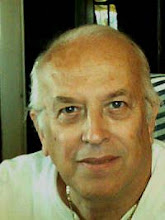
If you ask art dealers and auctioneers about who are the most famous Contemporary artists, you have a good chance to obtain very different answers. For instance, Philippe Segalot (picture at left), the French art consultant and former manager of Christie's contemporary art departement, think that there are no more than 10 great artists in any one generation. And he adds that those ten will show their prices grow while the others will simply disappear like fog.

For Segalot, among the ten best he puts Koons, Basquiat, Gonzales-Torres, Hirst and Cattelan. The other five, you might have never heard of them and among the best of the 21st century Segalot ranks Murakami, Toymans, Barney and Gober. I personally have never heard of the last three but I am not an expert and not even a specialist. So who are those famous three whose works we should rush to buy ?

Luc Tuymans (born 1958) is a Belgian contemporary artist (autoportrait on the right), considered one of today's most influential painters. Shame on me I did not know that. Tuymans was born in Mortsel, Belgium (double shame I live 3 years in Brussels and I still do not know it) and began to study fine art at the Sint-Lukasinstituut in Brussels in 1976. He first exhibited in 1985 and his first U.S. exhibition was at The Renaissance Society in Chicago in 1995. Tuymans lives and works in Antwerp. Recently some of his work has been exhibited in "The Triumph of Painting" exhibition in the Saatchi Gallery in London. In May 1995, the David Zwirner gallery featured a two-person exhibition of paintings by Francis Picabia and Luc Tuymans. The Museum of Modern Art hold six works by Tuymans. In October 2008 one of his paintings sold by Christie's London fetched almost 47,000 GBP ($70,000).


Matthew Barney (born in 1967 in San Francisco, California ) is an American contemporary artist who gained fame by a film called Cremaster cycle, a sequence of five films, entitled Cremaster 1 to Cremaster 5, which create a self-enclosed aesthetic system.

The conceptual departure point for the cycle is the male cremaster muscle, and the films are filled with anatomical allusions to reproductive organs and the process of sexual differentiation. Some critics think he is simply a buffoon, notably with regard to his second film, Drawing Restraint 9. Others thik he is a genius. Barney could well be the most important American artist of his generation. He produces films and videos, most of which he performs in. He and his crew also make sculptures and objects for the films and turn out photographs, books and installations derived from the films.

The sculptures include dumbbells made out of tapioca, a weight bench made of petroleum jelly, a mirrored saddle and nylon chairs with backrests curved at the waist so that only contortionists could sit comfortably on them. Barney doesn't regard any of his works — the sculptures, the photographs, the books, the films — as subsidiary to any others.


To say the least Barney (photo on the right) is not easily understandable and is very often provocative : I do not know what to make of his works and I send the reader to the
Gladstone gallery where more of this achievements can be seen.

In 2006, his works were exhibited at the show "all in the present must be transformed: Matthew Barney and Joseph Beuys," held by Deutsche Guggenheim, Berlin. In November 2008, one of his works fetched $86,500 on action at Phillips De Pury in New York. He is acclaimed all over and his works are walked around the museums and galleries of the planet.

The third great artist of our fresh century is or may be Robert Gober,
an American sculptor, who was born in Connecticut, in 1954. He studied at Middlebury College, Vermont Tyler School of Art in Rome. He lives and works in New York City and is represented by the Matthew Marks Gallery.

His work is often related to domestic and familiar objects such as sinks, doors, and legs, and has themes of nature, sexuality, religion, and politics. The sculptures are meticulously handcrafted, even when they appear to just be a re-creation of a common sink.

His work is in many museum collections, including the Whitney Museum of American Art, The Museum of Modern Art, San Francisco Museum of Modern Art, Solomon R. Guggenheim Museum, the Menil Collection, the Tate Modern.

This hanging bulb is an enamel, beeswax and rope measuring 8 x 3 x 3in. (20 x 7.5 x 7.5cm.) and was executed in 1990. At auction in June 2008, it fetched £457,250 ($911,300) at Christie's London.

Author Don Thompson, after a comprehensive survey and study of the Art market, cites 25 major Contemporary artists : Jasper Johns, Andy Warhol, Gehrard Richter, Bruce Nauman, Roy Lichtenstein, Robert Rauchenberg,
Joseph Beuys, Ed Ruscha, Francis Bacon, Lucian Freud, Cy Twombly, Damien Hirst, Jeff Koons, Martin Kippenberger, Donald Judd, Willem de Kooning, Takashi Murakami, Peter Fischli, Richard Serra, Antoni Tapies, Maurizio Cattelan, Andreas Gurky, David Hockney, Rochard Diebenkorn and Jean Michel Basquiat. To tell the truth before to read his study (1) I had never heard of 9 of them.


(1) Don Thompson, The 12 million Stuffed Shark, 2008, Palgrave, Macmillan