The 10 most expensive American painters are Rothko, Warhol, Bellows, De Kooning, Hopper, Koons, Smith, Sargent, Feininger and Peale.
Mark Rothko, born Marcus Rothkowitz (1903–1970), was a Latvian-born American painter and printmaker who is classified as an abstract expressionist, although he rejected not only the label but even being called an abstract painter.
He emigrated with his mother and sister in the USA in 1913 and went to the New School of Design in 1923 , where one of his instructors was the artist Arshile Gorky.
Rothko suffered from an aneurysm in 1968 and committed suicide in 1970. He was entered in Sharon Gardens in Kensico Cemetery in Valhalla, N.Y. The most expensive of his work was sold for $ 72,8 million in May 2007 and was a picture titled White Center.
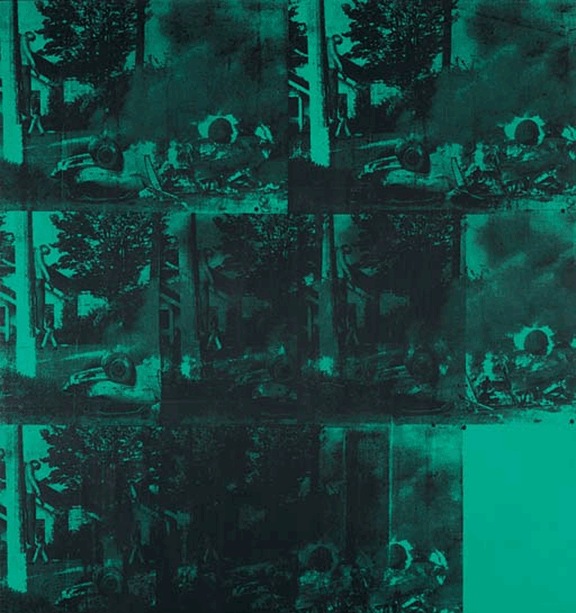
Second is the inimitable Pittsburgh-born Andy Warhol
 whose Green Car Crash sold in 2007 for $ 71,7 million. Andrew Warhola (August 6, 1928 – February 22, 1987) was an American artist and a figure in the movement known as pop art. After a successful career as a commercial illustrator, Warhol became famous worldwide for his work as a painter, avant-garde filmmaker, record producer, author, and public figure.
On June 3, 1968, crazy feminist anti-male Valerie Solanas shot Warhol and art critic Mario Amaya at Warhol's studio. Warhol died in New York City at 6:32 a.m. on February 22, 1987. According to news reports, he had been making good recovery from a routine gallbladder surgery at New York Hospital before dying in his sleep from a sudden post-operative cardiac arrhythmia. Prior to his diagnosis and operation, Warhol delayed having his recurring gallbladder problems checked, as he was afraid to enter hospitals and see doctors. The wounds of the 1968 shot left serious complications that certainly led to his sudden death.
The third of the most expensive Americans is George W.Bellows (1882-1925), a painter, known for his bold depictions of urban life in New York City. At a young age he was to become "the most acclaimed artist of his generation".
 Bellows was born in Columbus, Ohio.
Bellows was soon a student of Robert Henri at the New York School of Art, and became associated with Henri's "The Eight" and the Ashcan School, a group of artists who advocated painting contemporary American society in all its forms. By 1906, Bellows was renting his own studio. He died on January 8, 1925 in New York City, of peritonitis, after failing to tend to a ruptured appendix.
His mots expensive work was sold in 2007 for $ 27.7 million and is titled Men of the Docks , painted in 1912, a monumental masterwork by the undisputed leader of the Ashcan School.
Fourth is the famous Dutch-American Willem de Kooning ( 1904 – 1997) an abstract expressionist painter, born in Rotterdam (The Netherlands). His early artistic training included eight years at the Rotterdam Academy of Fine Arts and Techniques. In the 1920s he worked as an assistant to the art director of a Rotterdam department store. In 1926, De Kooning entered the United States as a stowaway on a British freighter and in 1927 he settled in Manhattan. In October 1935, De Kooning began to work on the WPA (Works Progress Administration) Federal Art Project, and he won the Logan Medal of the arts.
Developing a bold style of gestural paintings, he produced figure paintings and abstract, urban landscapes throughout the 1950s. In the following decade, pastoral themes replaced the urban violence of his earlier expressionist work. In 1963, de Kooning moved from a Manhattan loft to his newly built studio in the East Hampton community of the Springs. The North Atlantic light and flat beaches of Long Island inspired the luminous paintings of de Kooning's later career.
He made many canvasses about women, all distorted and rather monstruously looking.
 For that reason, he has sometimes been accused of being a woman-hater. In the 80s, Willem de Kooning was diagnosed with, in all probability, Alzheimer's disease. After his wife, Elaine, died on February 1, 1989, his daughter, Lisa, and his lawyer, John Eastman were granted guardianship over a De Kooning, alcoholic and sick. His most expensive work Untitled XXY sold in 2006 for $ 27.1 million.
 Fifth place is Edward Hopper (1882 – 1967), a prominent realist painter and printmaker. While most popularly known for his oil paintings, he was equally proficient as a watercolorist and printmaker in etching. Hopper was born in upper Nyack, New York, a yacht-building center north of New York City, the only son of comfortably well-off middle class family.
His parents were of Dutch ancestry. Hopper began his art studies with a correspondence school in 1899. Soon, however, he transferred to the far more prestigious New York Institute of Art and Design. There he studied for six years, with teachers including William Merritt Chase who instructed him in oil painting. In 1913, at the famous Armory Show, Hopper sold his first painting, Sailing (1911), which he painted over an earlier self-portrait. Hopper was thirty-one.
 At forty-one, Hopper finally received the recognition he had sought, but he continued to harbor bitter feelings about his career, later turning down appearances and awards.
His financial stability now secured, Hopper would live a simple, stable life and continue creating art in his distinctive style for four more decades. He died in 1967, in his studio near Washington Square, in New York City. His wife, who died 10 months later, bequeathed their joint collection of over 3,000 works to the Whitney Museum of American Art. His Hotel Window painting -an oil on canvas made in 1955- fetched $26.8 million in November 2006 at Sotheby's. It has been estimated at 10-15 million.
The following most expensive American painter is the
 provocative and publicity-hungry Jeff Koons, born in York, Pennsylvania in 1955. He studied at the Maryland Institute College of Art in Baltimore and the School of the Art Institute of Chicago.
He received a BFA from the Maryland Institute College of Art in 1976. Mr. Koons lives and works in New York City and York, Pennsylvania. Koons is also known for his public sculptures, such as the monumental floral sculptures Puppy, shown at Rockefeller Center and permanently installed at the Guggenheim Bilbao, and Split-Rocker, exhibited at the Palais des Papes in Avignon, France. Most recently, in 2006, Balloon Flower (Red) was unveiled at 7 World Trade Center in New York City and he held a very controversial show in Fall 2008 at the Chateau de Versailles, near Paris.
His most expensive work Hanging Heart sculpture (above) fetched $ 25.7 million at a Sotheby's sale in New York in November 2007. The 9ft-tall sculpture was created in stainless steel and consists of a giant heart, weighing 3,500lbs (1,600kg), suspended from the ceiling by two delicate gilded strands and hovering 16 inches (40cm) from the floor. The sculpture took 10 years to complete and was bought by the NYC-based Gagosian Gallery.
Another expensive American artist is an Abstract Expressionist sculptor, named David R. Smith (1906-1965), founding member of the American Abstract Artists group in 1936 whose most expensive piece called Cubi XXVIII went for $ 23.8 million in 2005. It became the most expensive contemporary artwork ever sold at auction.
Art dealer Larry Gagosian, bidding on behalf of billionaire Eli Broad (from Kauffman and Broad), won it at Sotheby’s for this huge sum of money. “I was prepared, frankly, to pay more than what I bid,” Broad said after the sale. The deep-pocketed collector is funding the $60 million expansion of the Los Angeles County Museum of Art, where the Smith is now on display.
Smith came to sculpture through painting, having trained at the Art Students League from 1927 to 1932. Like many of his fellow artists, he then worked in the WPA Federal Art Project. Significant friendships—and aesthetic affinities—with John Graham, Jackson Pollock, Robert Motherwell, and many of the Abstract Expressionist painters contributed to his development.
Profoundly influenced by the welded sculptures of Julio González and of Picasso, Smith started devoting himself entirely to metal sculptures, constructing compositions from steel and "found" scrap material. In the summer of 1929, Smith, along with his then wife Dorothy Dehner, bought a house in Bolton Landing, in upstate New York and won the Logan Medal of the arts.
He began his Cubi series of monumental, geometric steel sculptures in 1961 (although he began in earnest only in 1963).
 They are considered some of the most important works of 20th century American sculpture. In recognition of his influence on abstract expressionism, Smith was appointed to the National Council on the Arts by President Lyndon B. Johnson in 1965. However, at the peak of his influence and still working on Cubi, he died in a car crash near Bennington, Vermont in May 1965.
 Still in the range of the 20 million dollars, we have the painter John S. Sargent, ( 1856–1925) who was the most successful portrait painter of his era. Born in Florence Italy from American parents John Singer Sargent had an attempt to study at the Academy of Florence but he failed, so he went to Paris where he began his art studies with Carolus-Duran.
 The young French portrait artist, who had a meteoric rise, was noted for his bold technique and modern teaching methods, and his influence would be pivotal to Sargent during the period from 1874-1878. In 1874, on the first attempt, Sargent passed the rigorous exam required to gain admission to the École des Beaux-Arts.
 During his career, he created roughly 900 oil paintings and more than 2,000 watercolors, as well as countless sketches and charcoal drawings. His oeuvre documents worldwide travel, from Venice to the Tyrol, Corfu, the Middle East, Montana, Maine, and Florida. After leaving Carolus-Duran’s atelier, Sargent visited Spain. There he studied the paintings of Velazquez with a passion, absorbing the master’s technique, and in his travels gathered ideas for future works.
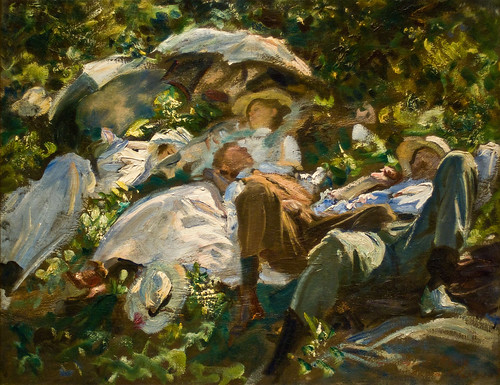
In a time when the art world focused, in turn, on Impressionism, Fauvism, and Cubism, Sargent practiced his own form of Realism, which brilliantly referenced Velázquez, Van Dyck, and Gainsborough. His seemingly effortless facility for paraphrasing the masters in a contemporary fashion led to a stream of commissioned portraits of remarkable virtuosity among them Teddy Roosevelt. In December 2004, Group with Parasols (A Siesta) (1905) sold for $US 23.5 million, nearly double the Sotheby's estimate of $12 million. The previous highest price for a Sargent painting was $US 11 million.
The ninth man on the list of the most expensive American artists is Lyonel Feininger (1871-1956) born to parents of German American descent and who grew up in New York City.
 Feininger only started working as an artist at the age of 36, after having worked as a commercial caricaturist for twenty years for various newspapers and magazines in both the USA and Germany; he was a member of the Berliner Sezession . He designed the cover for the Bauhaus 1919 manifesto - an expressionist woodblock 'cathedral'- and also taught at the Bauhaus for several years. In 1921, he had a joint exhibition with Paul Klee at the Weimar Museum.
With Cubist style and evocative color, he depicted modern life, especially factories, bridges, ships, harbors, and buildings. His most expensive painting The Jesuits III made in 1915 sold for $23,2 million estimated $7 - 9 million at Sotheby's NY on May 8 th 2007.
The less expensive of the most expensive is Charles W. Peale (1741-1827), born in Chestertown, Maryland. He followed for some time the trade of a saddler in Annapolis, but, having seen a portrait while visiting Norfolk, Virginia, he determined to attempt art, and on his return he executed a likeness of himself.
 His success induced him to change his vocation from saddle making to portrait painting. He lived in Boston in 1768'9, where he had some instruction from John Singleton Copley, and in 1770 he went to London, England, bearing letters to Benjamin West, who received him kindly, and whose pupil he became. He returned to Annapolis in 1774, began painting portraits, and two years later established himself in Philadelphia.
 He also began to take an active interest in political affairs, and was a member of the legislature in 1779. Afterward he turned his attention to natural history : he lived to assist in establishing the Pennsylvania academy of the fine arts and to contribute to seventeen of its annual exhibitions. Peale is notable rather for versatility than for real genius in any direction and his fame rests mainly on his achievements as a portrait painter, among which those of George and Martha Washington, John Hancock, Benjamin Lincoln, Baron Steuben, Count Rochambeau, Benjamin Franklin, Thomas Jefferson, John Witherspoon, and Alexander Hamilton f James Monroe, Andrew Jackson, John Quincy Adams, John C. Calhoun, and Henry Clay .
He opened in Philadelphia his own museum that housed a diverse collection of botanical, biological, and archaeological specimens. Most notably, the museum contained a large variety of birds which Peale himself acquired, and it was the first to display North American mammoth bones and it became eventually the Peale Museum. I n January 2005, a full length portrait of "Washington at Princeton" from 1779 sold for $21.3 million - setting a record for the highest price paid for an American portrait.
The popular success of George Washington at Princeton led to orders for as many replicas as Peale could produce. In August 1779 the artist wrote: “I have on hand a number of portraits of Gen. Washington. One the ambassador had for the Court of France, another is done for the Spanish Court, one other has been sent to the island of Cuba, and sundry others, which I have on hand are for private gentlemen.” Versions vary in size and composition–-with the background and the treatment of the figure of Washington altered by Peale. Changes included replacing the soldiers and horses with a bleak winter landscape, updating the general’s insignia according to the most recently issued orders, and giving greater prominence to the colonial flag. Other full-length versions by Charles Willson Peale are found at Princeton University in New Jersey, the Metropolitan Museum of Art in New York, Colonial Williamsburg, and the Virginia Museum of Fine Arts.